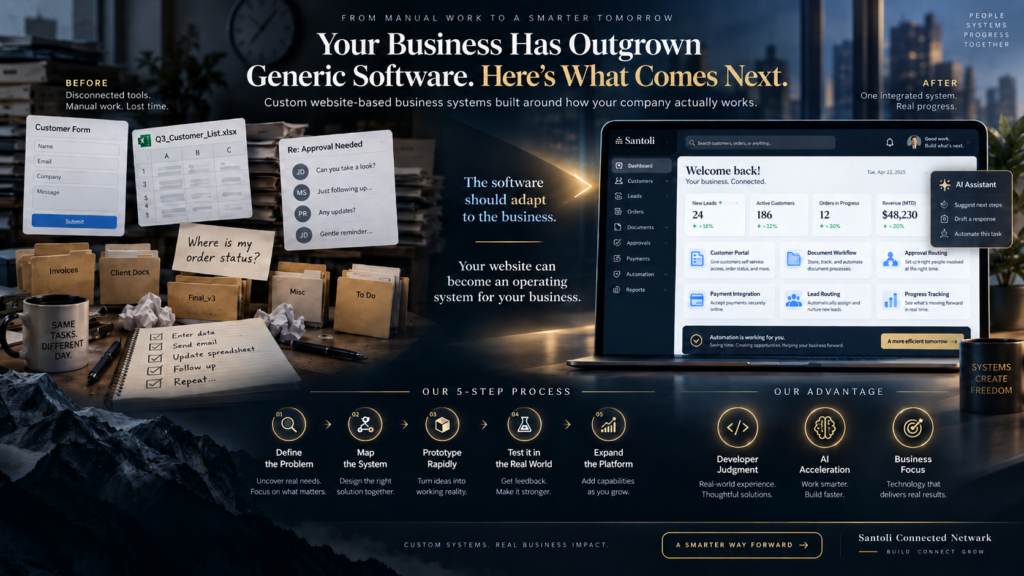


When something inside a business stops working efficiently, one of the first reactions is often to look for another piece of software. Maybe the company needs a new CRM, project management platform, WordPress plugin, automation service, AI tool, or customer portal. There are thousands of products promising to make businesses faster and more efficient, and many of them are genuinely useful. The problem is that adding another tool does not necessarily fix the underlying process. In some cases, it simply creates another login, another monthly subscription, another place where information is stored, and another system employees have to learn.
The real problem may not be that your business needs more software. It may be that nobody has stepped back and looked at how your existing systems, people, information, and processes actually work together. A process that made perfect sense when a company had five employees can become a major bottleneck when it has twenty. A spreadsheet that once kept everything organized can eventually become something everyone is afraid to modify. An inbox that worked for handling a few customer requests can become impossible to manage as volume increases.
These problems tend to develop gradually, which is why businesses often learn to live with them. Employees create workarounds, customers learn that they need to call for updates, managers ask for reports that have to be assembled manually, and information gets copied from one system into another because the systems do not communicate.
That is exactly why we created the Free Santoli Business Systems Audit.
Before You Build Anything, Find the Friction
Good technology should solve a specific business problem, but many technology projects begin in reverse. A company chooses a product first and then tries to modify its processes to fit the limitations of that product. Eventually, the business may have a CRM handling one part of the operation, spreadsheets handling another, documents stored somewhere else, customer communication happening through email, and employees manually connecting all of those systems together.
A better approach is to begin by examining the process itself. Where does work slow down? Where are employees entering the same information multiple times? Where are customers waiting for answers because someone internally has to check the status of something? Where are documents being emailed back and forth? Where does management lack real-time visibility? Which repetitive tasks are consuming hours every week even though they follow predictable rules?
Those questions are much more valuable than simply asking, “What software should we buy?” Once the actual friction is identified, it becomes possible to determine whether the solution should involve automation, integration, custom development, AI, a better workflow, or perhaps something much simpler.
The Santoli Business Systems Audit was designed to help businesses begin that process.
What Is the Santoli Business Systems Audit?
The Santoli Business Systems Audit is a free online diagnostic that evaluates how effectively technology supports the way your business operates. It consists of 18 questions across six areas of the business and typically takes about five minutes to complete. The questions are intentionally focused on business operations rather than technical terminology, so you do not need to understand software development, APIs, databases, automation platforms, or artificial intelligence to complete it.
Once the audit is finished, you receive a Business Systems Readiness Score out of 100 along with individual scores for the six areas being evaluated. More importantly, the audit identifies the areas where your business may have the greatest opportunity for improvement and provides recommendations based on your answers.
The purpose is not to tell you that every part of your business needs to be rebuilt. In fact, the opposite is true. We want to identify what is already working, what may be creating unnecessary friction, and where improving one or two processes could have a disproportionate impact on the organization.
1. Workflow & Operations
Every business has workflows whether they are formally documented or not. A lead enters the company, someone reviews it, information gets collected, an employee completes a task, another person approves something, a customer receives an update, documents are stored, and eventually the process moves toward completion. The important question is whether those steps happen through a deliberate system or whether employees are responsible for remembering how to connect everything.
When workflows depend heavily on email threads, spreadsheets, text messages, handwritten notes, or institutional knowledge held by a few employees, the business can become increasingly difficult to scale. A new employee may need months to understand a process that could have been built directly into the system. A manager may have to ask several people for updates because there is no central place to see what is happening. A customer may have to call because the company has the information internally but has no way to make that information visible externally.
The audit evaluates how structured those workflows are and whether technology is helping people complete the process or simply documenting what they already did manually.
2. Automation Readiness
Repetitive work is one of the clearest indicators that a process may be ready for automation. An employee may copy information from a website form into another system, manually send the same type of follow-up message dozens of times each week, create similar documents repeatedly, update spreadsheets after every transaction, or move information between platforms that were never connected.
Individually, these tasks may only take a few minutes. That makes them easy to ignore. When the same task is repeated hundreds or thousands of times throughout a year, however, those minutes become a significant amount of labor. They also create opportunities for human error because employees are spending time performing predictable administrative tasks instead of work that actually requires human judgment.
The audit looks at whether your current processes contain these types of repetitive activities and whether they are structured enough to be automated. The goal is not automation for the sake of automation. It is to identify work that computers should be doing so that people can spend more time on the work that actually requires people.
3. Customer Experience
Customers may never know what CRM you use, what database stores their information, or what technology powers your website, but they absolutely experience the consequences of those systems. They notice when they have to provide the same information more than once, when nobody can tell them the status of a request, when they wait several days for a response, or when completing a simple process requires multiple phone calls and emails.
A well-designed business system should make the company easier to interact with. Customers should be able to provide information efficiently, receive relevant updates, complete appropriate tasks themselves, and understand what happens next. At the same time, employees should have the information necessary to serve those customers without searching through several disconnected platforms.
The audit evaluates the customer experience from this systems perspective because many problems that appear to be customer-service problems are actually process and technology problems happening behind the scenes.
4. Data & Visibility
Most growing businesses do not suffer from a lack of data. They suffer from having data in too many places. Customer information may be stored in a CRM, operational information in spreadsheets, documents in cloud storage, financial information in another platform, and important status updates inside email conversations. When management wants to understand what is happening, someone has to collect information from several sources and assemble it into a report.
That makes decision-making slower and creates uncertainty about which information is current. It also means employees may spend a surprising amount of time simply searching for information that the business already possesses.
The Data & Visibility portion of the audit examines whether important information is accessible when it is needed, whether employees can understand the current status of work, and whether leadership has enough visibility to make decisions without constantly requesting manual updates.
5. Security & Control
Security is often discussed in terms of hackers, passwords, and malware, but good business-system security goes much further. It includes understanding who can access customer information, who can download sensitive documents, whether former employees still have access to systems, whether changes can be traced back to individual users, and whether different employees have permissions appropriate to their responsibilities.
As businesses grow, informal methods of sharing information can create significant problems. Sensitive documents may be sent through email simply because that is the easiest way to move them. Multiple employees may share credentials. Files may be downloaded without any audit trail showing who accessed them. These practices can continue for years without causing an obvious problem, but they become increasingly risky as the amount and sensitivity of information grows.
The audit evaluates whether your existing processes provide an appropriate level of structure, accountability, and control around the information your business depends on.
6. AI Opportunity
Artificial intelligence is creating entirely new possibilities for business automation, but the most valuable AI projects rarely begin with the statement, “We need AI.” They begin with a specific business process that could be improved. AI can help summarize information, extract structured data from documents, categorize incoming requests, draft communications, analyze conversations, search internal knowledge, assist employees with decisions, and perform repetitive research. The opportunity becomes much more meaningful when AI is integrated into a workflow instead of being treated as a separate novelty.
For example, a company processing large numbers of documents may benefit from AI-assisted extraction and classification. A company handling repetitive customer inquiries may benefit from an AI system connected to its actual business information. Another company may discover that traditional automation can solve its problem more reliably and inexpensively than AI.
The audit looks for situations where AI could create practical business value while keeping the focus on the outcome rather than the technology itself.
What Does Your Business Systems Readiness Score Mean?
After completing the audit, your answers are converted into an overall Business Systems Readiness Score. Depending on the results, a business may fall into a stage such as Manual & Fragmented, Functional but Constrained, Connected & Ready to Scale, or System-Driven. The classification provides a high-level picture of how effectively technology is supporting the organization today.
A lower score does not mean that a business is poorly run. In many cases, it means exactly the opposite: the business has successfully grown beyond systems that were originally built for a much smaller operation. Employees may be compensating for limitations through experience and hard work, which allows the company to continue operating even when the underlying technology has not kept pace with its growth.
A higher score does not mean there is nothing left to improve either. Businesses with stronger technology foundations often have opportunities for deeper automation, better integrations, more sophisticated reporting, or carefully implemented AI. The purpose of the score is to establish a baseline and help identify where further investigation is most likely to produce meaningful results.
More Important Than the Score: Your Three Priority Opportunities
A score by itself is interesting, but it is not particularly actionable. That is why the Santoli Business Systems Audit also identifies three priority opportunities based on your responses. These are the areas where we believe additional attention could create the greatest impact.
One company might discover that its customer experience is excellent but its employees are spending too much time manually moving information between systems. Another may have highly efficient internal workflows but poor visibility for management. Another may already have a strong digital infrastructure but have several processes that could benefit from AI-assisted automation.
The objective is to move the conversation from the vague idea that “we need better technology” toward something much more useful: “This is the process we should investigate first, and this is why.”
Once a problem can be described that clearly, designing the right solution becomes much easier.
What Happens After You Complete the Audit?
There is no obligation attached to completing the audit. You can review the results, share them with your team, use the recommendations internally, or simply use the exercise as an opportunity to think differently about how your company operates. You may even discover that the systems you already have are working better than you expected.
If the audit identifies an area you would like to improve, however, the results give us a much better starting point for a conversation. Instead of beginning with a generic discussion about websites or software, we can talk about the actual process causing friction, what the ideal workflow would look like, who needs to interact with it, what information needs to move through it, and which parts could potentially be automated.
That is much closer to how we approach development at Santoli Connected Network. We are not interested in forcing every business into the same technology stack or selling software simply because it exists. We start with the business problem and determine what technology makes sense around it.
Your Business Is Already a System
Every company is ultimately a collection of connected systems. Leads become customers, information moves between employees, decisions trigger actions, documents change hands, payments are processed, projects advance, and customers expect communication throughout the process. Technology can make those connections almost invisible when it is designed well, or it can make every step more difficult when the systems are fragmented.
The challenge is that inefficiencies become familiar. If employees have copied information into the same spreadsheet for three years, it simply becomes part of the job. If customers have always called for status updates, nobody may stop to ask why they cannot see the status themselves. If management has always waited until Friday for someone to assemble a report, the organization may not consider what would change if that information were available in real time.
Sometimes the most valuable technology project begins simply by asking whether those processes still make sense.
Take the Free Santoli Business Systems Audit
The Free Santoli Business Systems Audit gives you a structured way to ask those questions. In about five minutes, you will work through 18 questions covering Workflow & Operations, Automation Readiness, Customer Experience, Data & Visibility, Security & Control, and AI Opportunity. When you finish, you will receive your Business Systems Readiness Score, individual category scores, three priority opportunities, personalized recommendations, and a copy of the results by email.
You do not need a technology plan before you begin, and you do not need to know what you want us to build. In fact, that is part of the reason the audit exists. If you know there are processes inside your business that could work better but you are not sure what the solution should be, this is a much better place to start.
Take the Free Santoli Business Systems Audit and find out where your business has the greatest opportunity to improve next.
Start the audit at: santoli.us/business-systems-audit/.